

“OF” is a common internet abbreviation that most people use to mean “OnlyFans.” It shows up in captions, bios, comments, and casual chats online. People use it as a quick way to reference the platform without spelling it out.
The short form became popular because it’s faster to type and easier to hide from casual scrollers. Many creators use “OF” in their social media bios to link followers to their content elsewhere. Over time, it turned into everyday slang across TikTok, Instagram, and Twitter/X.
By 2026, “OF” is widely recognized slang, even by people who don’t use the platform themselves. It’s used in jokes, memes, and casual conversation online. Its meaning is now well understood across most social media spaces.
OF Meaning Slang – Quick Meaning
“OF” is most often short for OnlyFans, a subscription platform where creators share exclusive content with paying fans. It’s used as a fast, casual way to reference the platform without spelling it out.
Common Meanings
- OnlyFans the most common meaning by far, used across social media.
- Odd Future a hip-hop collective, used mostly in music-related chats.
- Oh F*!** a quick reaction to shock or surprise.
- Old Fart a joking insult about someone’s age.
- Only Friends a blunt way of saying there’s no romantic interest.
Examples
- “She just started an OF, check her bio.”
- “OF, I forgot my charger again.”
- “That’s OF energy right there 😂”
Origin and Background of OF Slang
The abbreviation “OF” existed long before it became linked to OnlyFans, but its current meaning took off alongside the platform’s rise.
- OnlyFans launched in 2016 as a subscription site for creators across many fields.
- Its popularity spiked in 2020 after mainstream pop culture references brought it wider attention.
- As usage grew, “OF” became shorthand across TikTok, Instagram, and Twitter/X.
- Social platforms began limiting the reach of posts that named the platform directly, which pushed the abbreviation into everyday use.
Real-Life Conversations Using “OF” Slang
Seeing “OF” used in real conversations makes the meaning much clearer.
WhatsApp Conversation
Sam: Hey, did you see Maya’s new page? Jess: Yeah, she posted about her OF this morning. Sam: Good for her, honestly.
Instagram DM
User1: love your content! do you have an OF? User2: yep, link’s in my bio 🔗
TikTok Comments
Comment: “the way she said ‘link in bio’ but we all know it’s OF 😭” Reply: “we support her fr”
Text Message Example
Text 1: “why’d he block you” Text 2: “told him we’re just OF now lol”
Emotional and Psychological Meaning
Beyond its literal definition, “OF” carries different emotional weight depending on tone and setting.
- Neutral: Often used matter-of-factly, without judgment.
- Playful: Common in memes, jokes, and teasing between friends.
- Loaded: Can carry stigma in more conservative spaces or families.
- Empowering: Some creators use it confidently as part of their personal brand.
The same two letters can feel completely different depending on who’s saying it and why.
Usage in Different Contexts
Where “OF” shows up changes how it’s read and understood.
Social Media
On platforms like TikTok, Instagram, and X, “OF” is common in bios, captions, and comment sections, usually tied to content promotion.
Friends and Relationships
Among friends, “OF” often comes up casually — supporting someone’s page, joking about it, or referencing the “only friends” meaning in dating talk.
Work or Professional Settings
“OF” essentially never appears in professional communication. It’s strictly informal, internet-native slang.
Casual vs Serious Tone
| Setting | Typical Tone | Example Use |
| Group chat with friends | Playful, joking | “say less, OF era incoming” |
| Creator’s public bio | Direct, promotional | “OF link below” |
| Family or formal setting | Rarely used | Almost never appears |
| Professional workplace | Not used | Not appropriate |
Common Misunderstandings About OF Slang
Because “OF” is so short, it’s easy to misread. Here are the most frequent mix-ups.
Thinking It Always Means OnlyFans
While it’s the most common meaning, context can point to “Odd Future,” “Oh F***,” or other meanings entirely.
Assuming It’s Always Inappropriate
“OF” is used casually and jokingly in plenty of everyday, non-serious conversations.
Confusing It With Other Abbreviations
Terms like “OFC” (of course) or “OFN” can look similar but mean something completely different.
Using It Without Context
Dropping “OF” into a sentence with no context can easily confuse the other person — context is what makes the meaning clear.
OF Compared to Similar Internet Terms
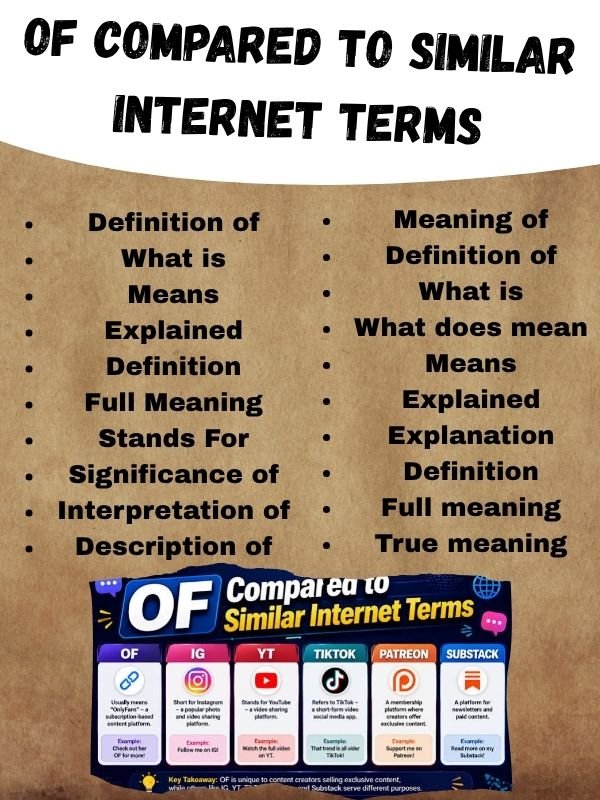
| Term | Meaning | Typical Use |
| OF | OnlyFans | Bios, captions, casual chat |
| LIB | Link in bio | Pointing to any external link |
| DM | Direct message | Private messaging |
| PPV | Pay-per-view content | Paid content unlocks |
| FYP | For You Page | TikTok algorithm reference |
“OF” stands out because it’s tied to one specific platform, while terms like “LIB” or “DM” are used more broadly across contexts.
Variations and Types of OF Slang
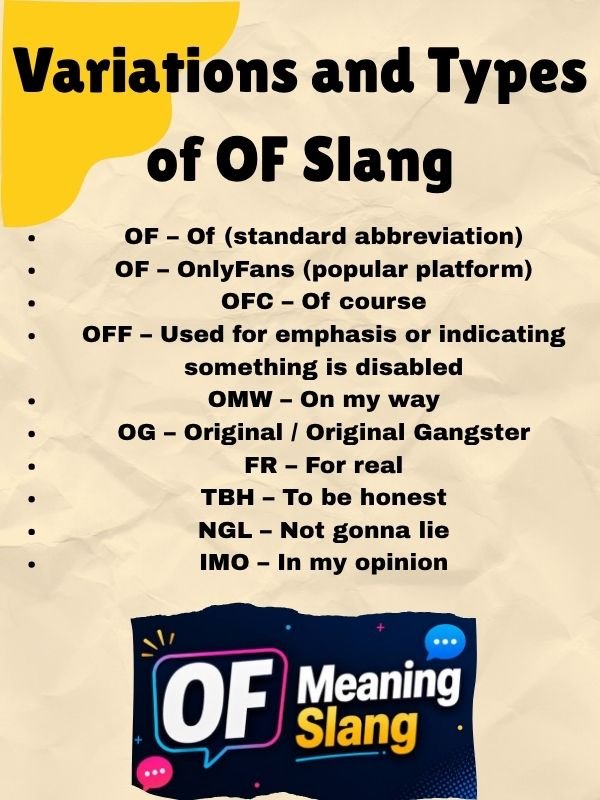
“OF” branches into several related terms, each describing a different part of the experience.
- OF account a general reference to someone’s profile on the platform.
- OF creator a person who posts and manages content for subscribers.
- OF model a creator, often used specifically for those posting photo or video content.
- OF page he profile page itself where content is shared.
- OF link the bio link that leads followers to the creator’s page.
- OF content material shared exclusively with paying subscribers.
- OF leak content shared outside the platform without permission, a well-known issue creators deal with.
- OF earnings the income a creator makes from subscriptions and tips.
- OF promotion posts, shoutouts, or collabs used to grow a subscriber base.
- OF subscriber someone who pays to access a creator’s page.
How to Respond When Someone Uses “OF”
The right reply usually depends on your relationship with the person and the setting.
Casual Replies
Keep it light: “oh nice, good luck with it” or a quick supportive emoji.
Funny Replies
Lean into humor: “say less 👀” or a playful meme-style comment.
Mature Replies
Stay respectful and direct: “thanks for sharing, appreciate it” without judgment.
Respectful Replies
Focus on support rather than commentary, especially in group or public settings.
Regional and Cultural Usage
Understanding of “OF” slang isn’t the same everywhere — cultural attitudes shape how openly it’s discussed.
Western Culture
In the US, UK, and much of Europe, “OF” is widely recognized and referenced casually, even in mainstream pop culture.
Asian Culture
In many Asian countries, OnlyFans faces more restriction or stigma, so “OF” tends to be used more privately.
Middle Eastern Culture
Access to adult-content platforms is often limited in the Middle East, making “OF” a more sensitive or rarely discussed term.
Global Internet Usage
Despite these regional differences, “OF” has spread globally as English-language internet slang travels fast through memes and shared platforms.
Also Read OF Meaning On MeaningPeak.com
Conclusion
OF” is internet slang that stands for “OnlyFans,” a platform people reference often online. It’s become a quick, easy shorthand used in bios, captions, and casual talk. Most people online instantly recognize what it means today.
This short abbreviation shows how internet slang saves time and space. It also shows how certain platforms become part of everyday online language. As with most slang, it’s helpful to understand the context before using it.
FAQ’s
What are the best apps to explore the concept of meaning in literature?
Apps like LitCharts and SparkNotes help explain themes and meaning in books. Goodreads also offers reader discussions on deeper meaning.
Which online courses explain the philosophy of meaning comprehensively?
Coursera and edX offer philosophy courses on language and meaning. Many are taught by professors from top universities.
What digital tools help analyze the meaning of words in texts?
Tools like Voyant Tools and WordSmith help study word meaning in texts. They highlight patterns, frequency, and context.
Can you recommend software for semantic analysis of meaning in large datasets?
Python libraries like spaCy and NLTK are popular for semantic analysis. Tools like MonkeyLearn also help with large-scale text analysis.

Hi, I’m an SEO specialist with a strong passion for digital marketing and search optimization. I focus on understanding how search engines work and how websites can improve their visibility through effective SEO strategies.
I enjoy working with data-driven approaches, including keyword research, on-page optimization, technical SEO, and content strategy. I believe every website has the potential to grow and reach new heights with the right techniques and consistent effort.
I value continuous learning and always stay updated with the latest trends and best practices in the digital world. My goal is to keep improving my skills and knowledge while exploring new opportunities in the field of SEO.
