

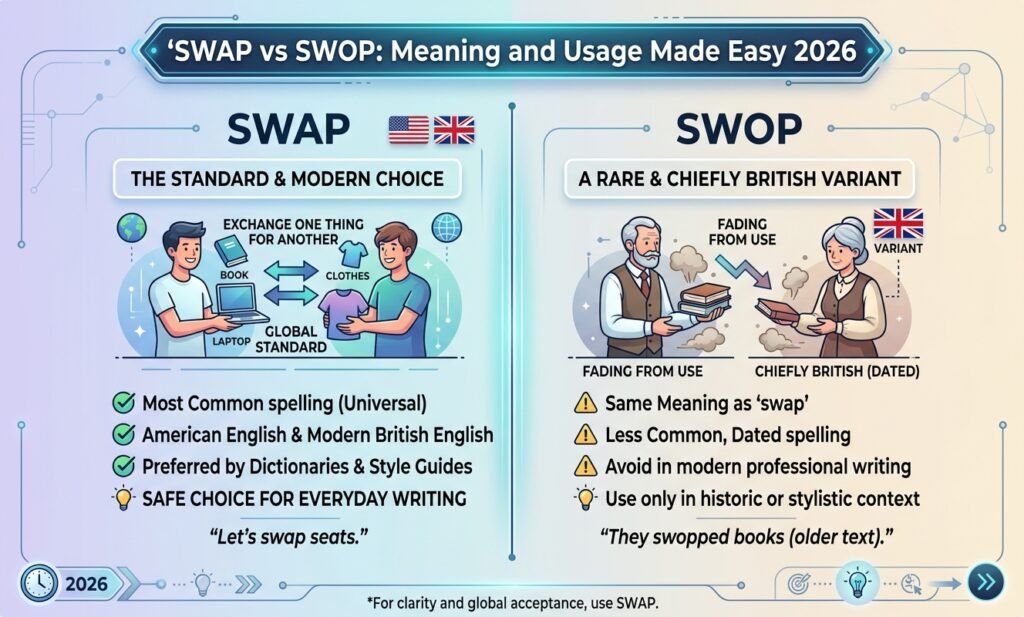
You see the word “swop” somewhere and pause. Is that even a real word, or just a typo for “swap”? It looks strange, but it’s actually correct.
“Swap” and “swop” mean exactly the same thing. Both describe exchanging one thing for another. The only real difference is spelling, not meaning.
“Swap” is the more common spelling used worldwide. “Swop” shows up mostly in older British English. Once you know this, the confusion disappears completely.
The Core Meaning Shared by Swap and Swop
Shared Meaning
Both “swap” and “swop” mean to exchange one thing for another. Whether it’s items, ideas, positions, or responsibilities, the action described is identical.
Very Simple Examples
- “They swapped seats.”
- “They swopped seats.”
Same sentence, same meaning, different spelling.
Understanding “Swap” in Detail
Meaning of “Swap”
“Swap” means to trade or exchange something with someone else. It works for physical objects, ideas, schedules, or roles.
Simple Examples
- “Let’s swap books after we finish reading.”
- “I swapped my sandwich for hers.”
- “We swapped stories about our trips.”
Grammar Forms of “Swap”
Verb Forms
| Form | Word |
| Base | swap |
| Past tense | swapped |
| Past participle | swapped |
| Present participle | swapping |
| Third person singular | swaps |
Examples in Sentences
- “I swap shifts with my coworker sometimes.”
- “She swapped her old phone for a new one.”
- “We are swapping ideas in the meeting.”
“Swap” as a Noun
“Swap” also works as a noun describing the act of exchanging something.
Examples
- “It was a fair swap.”
- “Let’s make a swap.”
- “The deal involved a swap of assets.”
Everyday Situations Where “Swap” Is Used
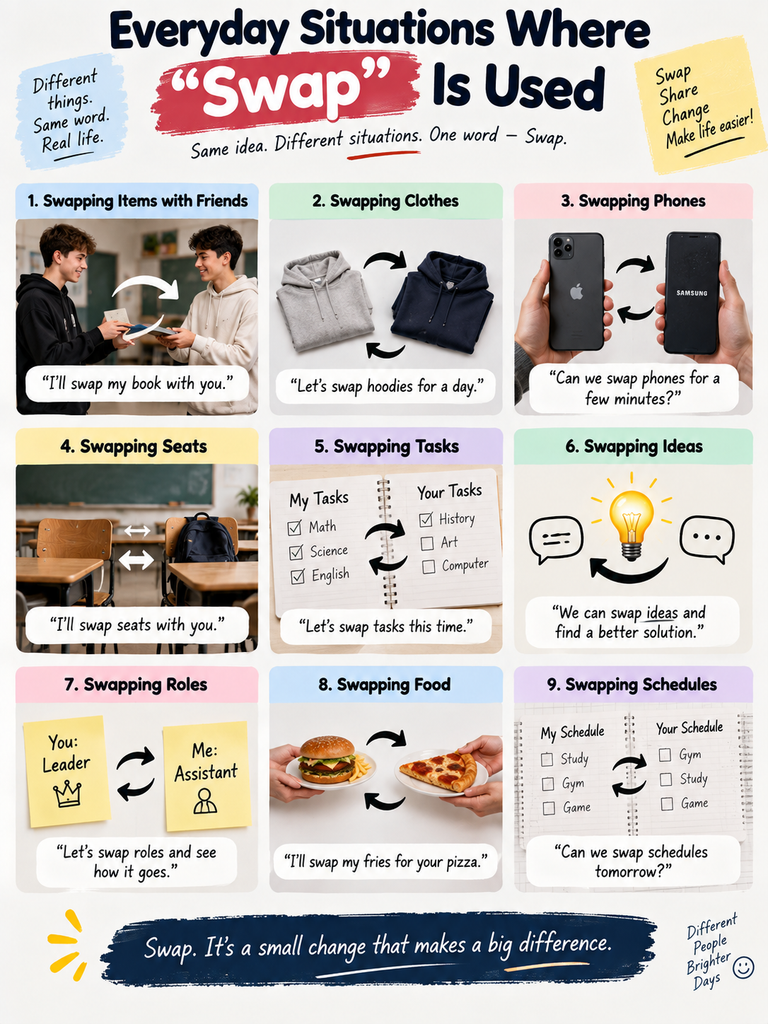
Daily Life
People swap seats, chores, clothes, and even favors with friends and family.
School and Office
Students swap notes and books. Employees swap shifts and desks.
Technology
Tech contexts use “swap” for SIM cards, hard drives, memory swapping in computing, and software components.
Business and Finance
Financial markets use “swap” for currency swaps, asset swaps, and interest rate swaps — all standard financial terms.
Understanding “Swop” in Detail
Meaning of “Swop”
“Swop” carries the exact same meaning as “swap.” It’s simply an older, less common spelling, mostly seen in British English.
Example
- “They swopped gifts before the trip.”
Is “Swop” Correct English?
Yes, “swop” is a genuine English word and not a spelling mistake. However, it has fallen out of common use, with most dictionaries listing it as a variant rather than the preferred form.
Swap vs Swop: Regional Usage
| Region | Preferred Spelling |
| United States | Swap only |
| United Kingdom | Swap (swop occasionally in older texts) |
| Australia | Swap |
| Canada | Swap |
British English
Even in the UK, “swap” has become the dominant spelling. “Swop” survives mostly in older literature, informal writing, or historical texts.
American English
American English recognizes only “swap.” Using “swop” in US writing tends to look outdated or incorrect to readers.
Swap vs Swop in Modern English
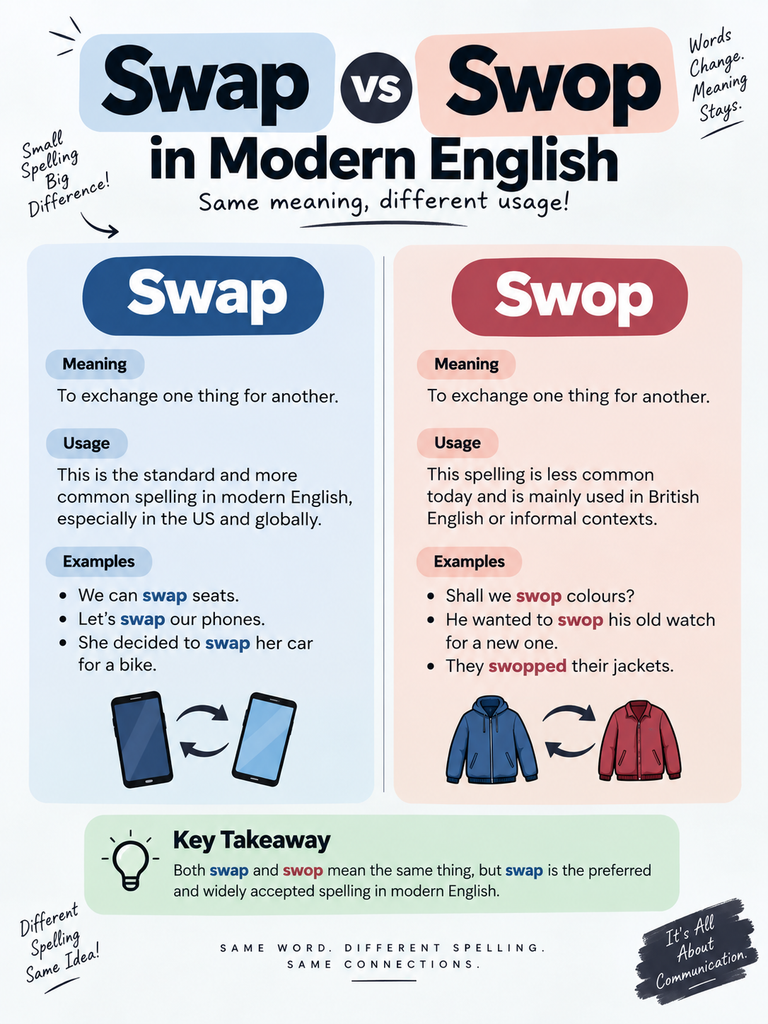
Modern English overwhelmingly favors “swap” across nearly every English-speaking country. It appears in newspapers, books, websites, and everyday conversation, while “swop” has become rare enough that many younger readers may not recognize it at all.
Swap vs Swop in Writing and Exams
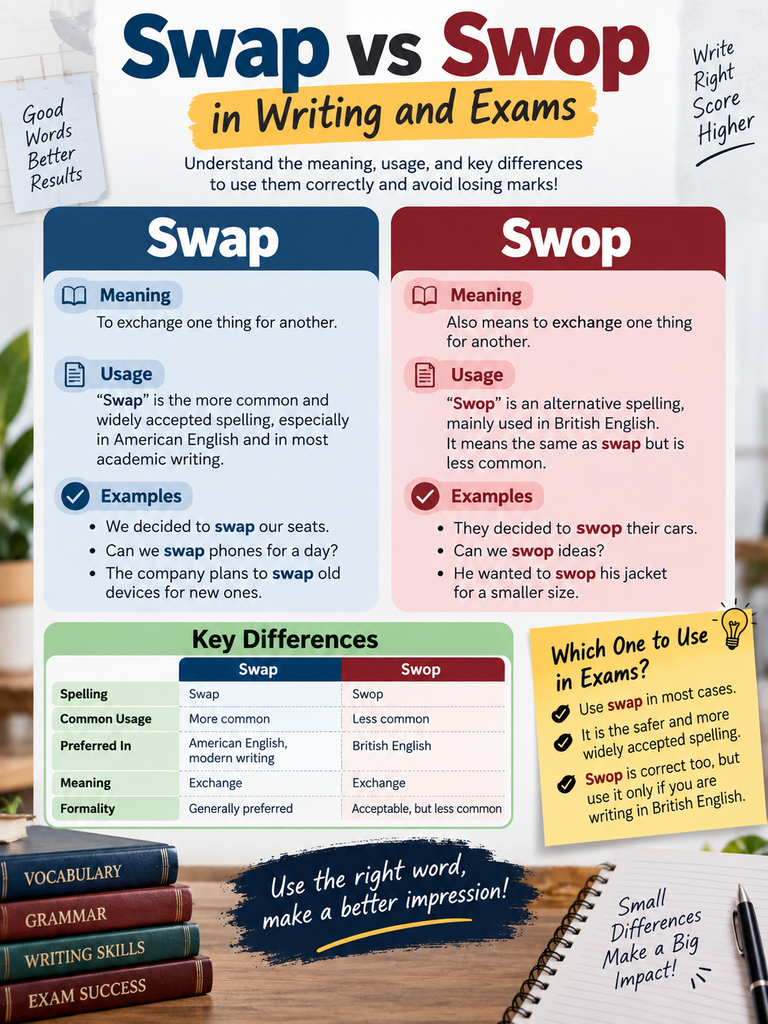
Writing
For blogs, emails, business writing, and general content, “swap” is the safer and clearer choice for a wider audience.
Exams
Standardized tests and academic writing almost always expect “swap.” Using “swop” could come across as a spelling error to graders unfamiliar with the variant.
Past Tense: Swap vs Swop
Swap (Past Form)
“Swapped” — as in, “They swapped phones yesterday.”
Swop (Past Form)
“Swopped” — as in, “They swopped phones yesterday.”
Both follow the same double-consonant pattern, but “swopped” looks unusual to most modern readers.
Swap vs Swop as Nouns (Detailed)
Swap as a Noun
- “It was a fair swap.”
- “The trade felt like a good swap.”
Swop as a Noun
- “It was a fair swop.” (rare, mostly historical usage)
Swap vs Swop in Idioms and Fixed Phrases
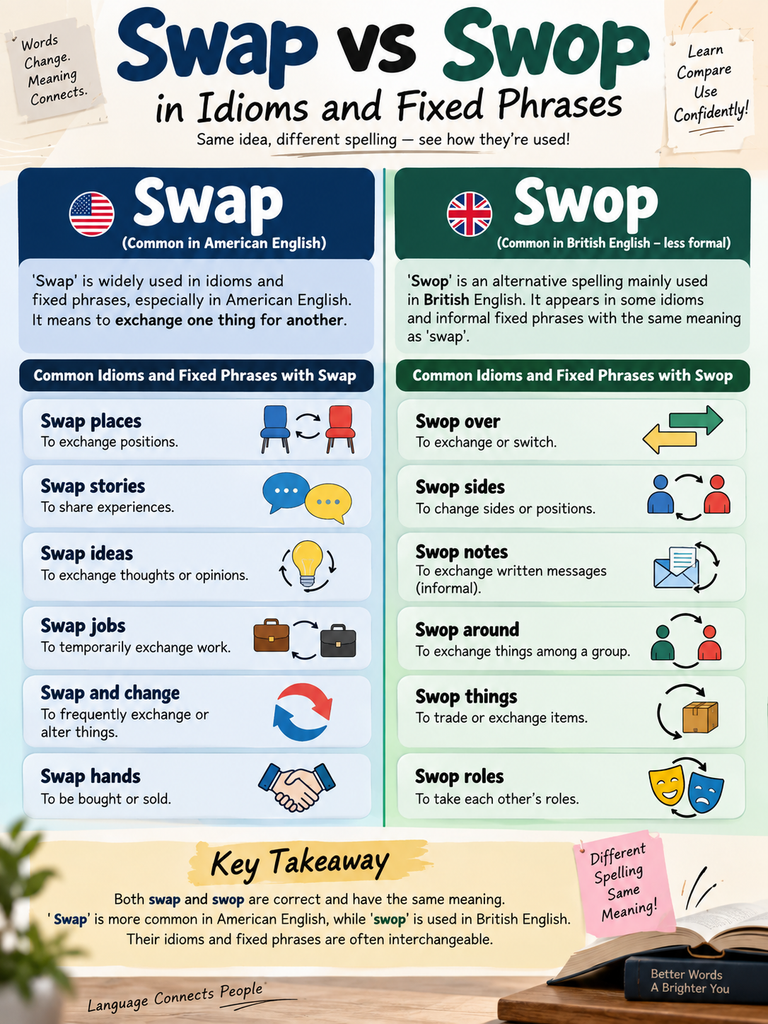
Common Phrases With Swap
- Swap meet
- Swap shop
- Job swap
- House swap
Phrases With Swop
There are no widely recognized fixed idioms using “swop” in modern English. Any idiomatic phrase almost always defaults to “swap.”
Swap vs Swop in Technology and Science
Technical and scientific fields exclusively use “swap.” Terms like memory swap, data swap, and swap file are standard in computing, while “swop” never appears in technical documentation.
Swap vs Swop in Business and Law
Legal and financial documents use “swap” as the standard term, especially in contracts involving currency swaps, asset swaps, and trade agreements. “Swop” has no place in formal legal or business writing.
Also Read LWK Meaning On Meaningpeak.com
Why “Swop” Is Slowly Disappearing
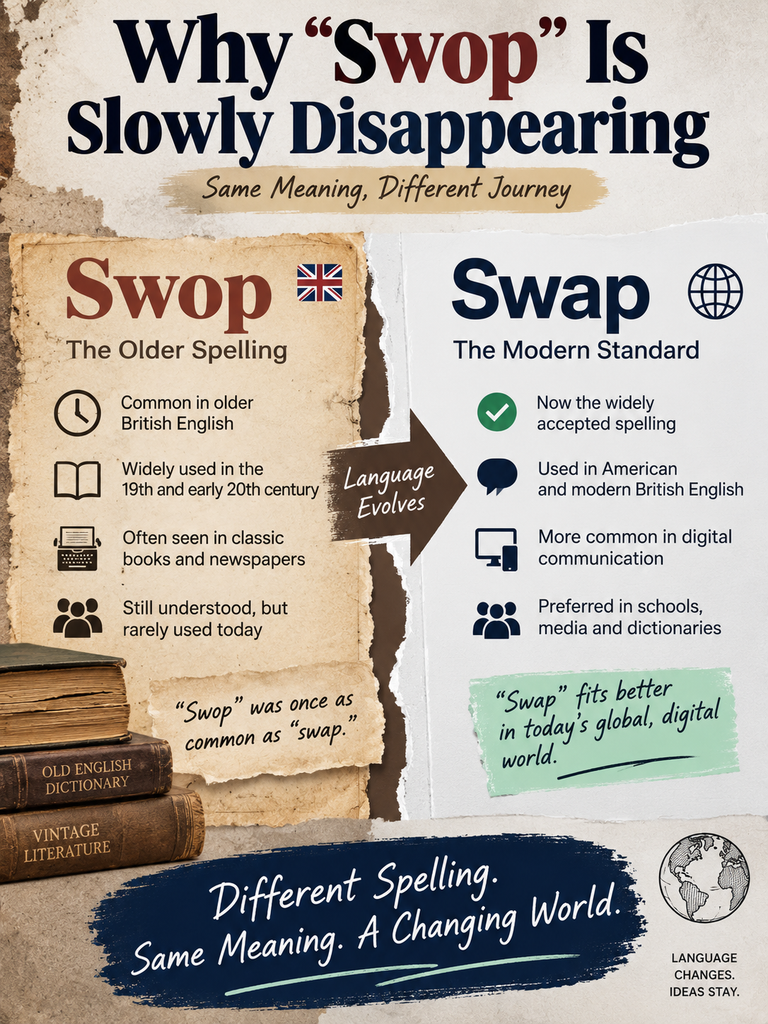
| Reason | Explanation |
| Dictionary preference | Modern dictionaries list swap as standard |
| Global communication | Swap works clearly across all regions |
| Publishing standards | Editors and publishers default to swap |
| Reader familiarity | Fewer readers recognize swop today |
Language naturally settles toward one dominant spelling over time, and “swap” has become that standard.
Common Mistakes Learners Make
- Assuming “swop” is a typo instead of a real word
- Using “swop” in American English writing
- Mixing spellings within the same document
- Believing the two words have different meanings
Very Simple Rule for Beginners
Use “swap” almost always. If you ever see “swop,” know it means the exact same thing, just in an older or British style.
Practice Exercises (Extended)
Fill in the blank with the correct modern spelling:
- Let’s ___ seats. → swap
- They ___ gifts yesterday. → swapped
- It was a fair ___. → swap
- Workers can ___ shifts. → swap
- We are ___ ideas right now. → swapping
Why Learning Swap vs Swop Is Important

Knowing this difference helps you write clearly and confidently, especially in professional or international communication. It also prevents confusion when reading older texts that still use “swop,” so you recognize it instantly instead of mistaking it for an error.
FAQs
Is swop a real word?
Yes, swop is a genuine English word, though it’s now rare in modern usage.
Do swap and swop mean different things?
No, both words mean exactly the same thing — to exchange one thing for another.
Which spelling should I use in writing?
Use “swap” for clarity, since it’s recognized globally across all English-speaking regions.
Is swop only used in British English?
Yes, swop appears mainly in older British English and rarely elsewhere.
Is swop grammatically incorrect?
No, it’s not incorrect, just outdated and far less common than swap.
Can swap be used as a noun?
Yes, swap works as both a verb and a noun, as in “It was a fair swap.”
Conclusion
“Swap” and “swop” are the same word with two different spellings. Both mean exchanging one thing for another, so neither one is wrong. “Swap” is simply the more common and widely accepted choice today.
Stick with “swap” for everyday writing, especially online or in the US. If you come across “swop,” just know it means the exact same thing.

Hi, I’m an SEO specialist with a strong passion for digital marketing and search optimization. I focus on understanding how search engines work and how websites can improve their visibility through effective SEO strategies.
I enjoy working with data-driven approaches, including keyword research, on-page optimization, technical SEO, and content strategy. I believe every website has the potential to grow and reach new heights with the right techniques and consistent effort.
I value continuous learning and always stay updated with the latest trends and best practices in the digital world. My goal is to keep improving my skills and knowledge while exploring new opportunities in the field of SEO.
