

You write a sentence and pause. Should it be “I feel tired” or “I felt tired”? Both look correct, but they tell different stories.
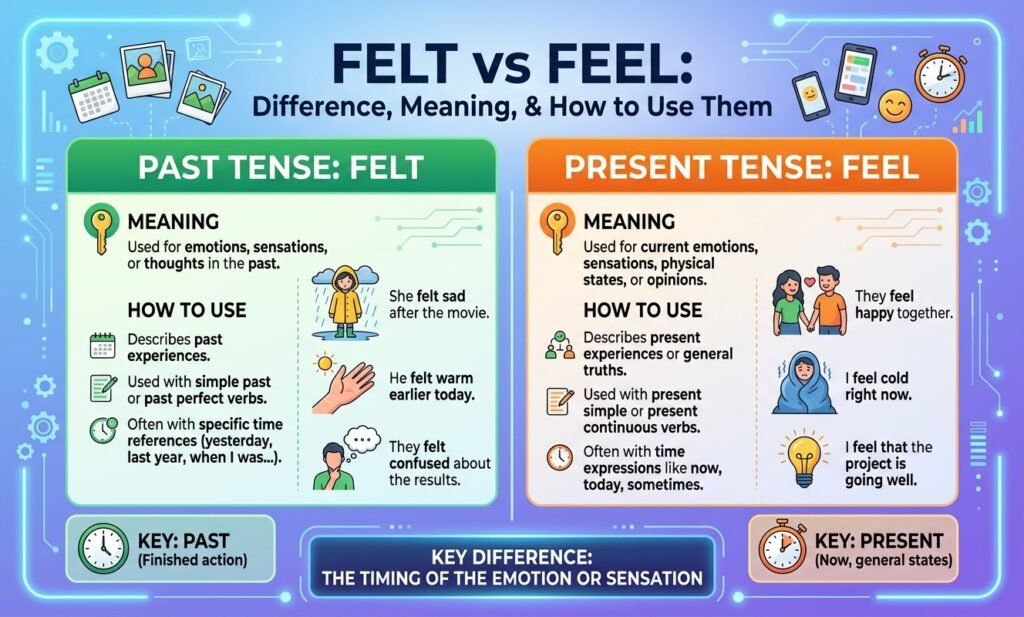
“Feel” describes something happening right now. “Felt” describes something that already happened in the past. The difference comes down to timing, not meaning.
Once you understand this simple rule, choosing between them gets easy. Your sentences will sound more natural, and your writing will feel more accurate too.
What Does Feel Mean?
Simple Meaning
“Feel” is the base form and present tense of the verb. It describes emotions, physical sensations, or opinions happening right now, or general truths that stay the same over time.
Examples
- “I feel happy today.”
- “She feels tired after the gym.”
- “This blanket feels soft.”
- “I feel like pizza tonight.”
What Does Felt Mean?
Simple Meaning
“Felt” is the past tense and past participle of “feel.” It describes an emotion, sensation, or opinion that already happened and is now finished.
Examples
- “I felt happy yesterday.”
- “She felt nervous before the interview.”
- “We felt the ground shake.”
- “They felt proud after the win.”
Key Difference Between Felt and Feel
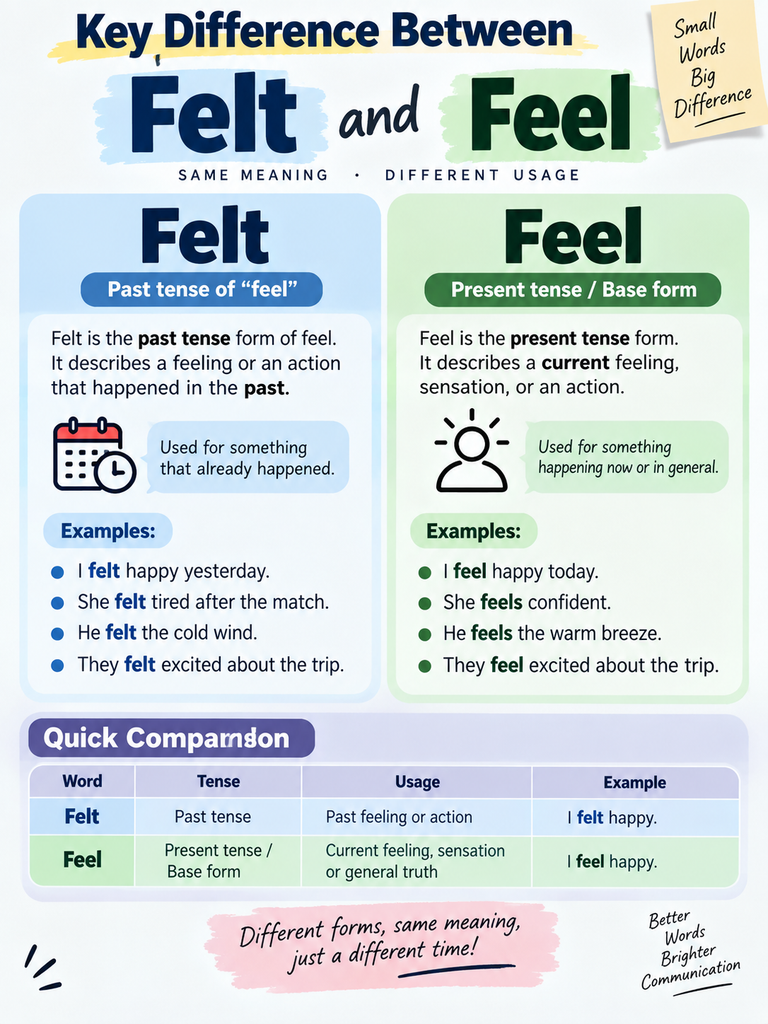
| Feature | Feel | Felt |
| Tense | Present | Past |
| Timing | Happening now | Already happened |
| Form | Base verb | Past tense / past participle |
| Example | I feel great. | I felt great yesterday. |
Simple Rule
If it’s happening now, use “feel.” If it already happened, use “felt.” That one rule covers almost every situation.
When to Use Feel
Use “feel” for present emotions, current physical sensations, opinions, and general truths.
Examples
- “I feel confident about this plan.”
- “He feels sick right now.”
- “The water feels cold.”
- “I feel this is the right choice.”
When to Use Felt
Use “felt” for anything that happened in the past, whether it’s a finished emotion, a memory, or a past reaction.
Examples
- “I felt exhausted after the trip.”
- “She felt relieved when the results came in.”
- “We felt scared during the storm.”
- “He felt proud of his team.”
Felt vs Feel in Sentences
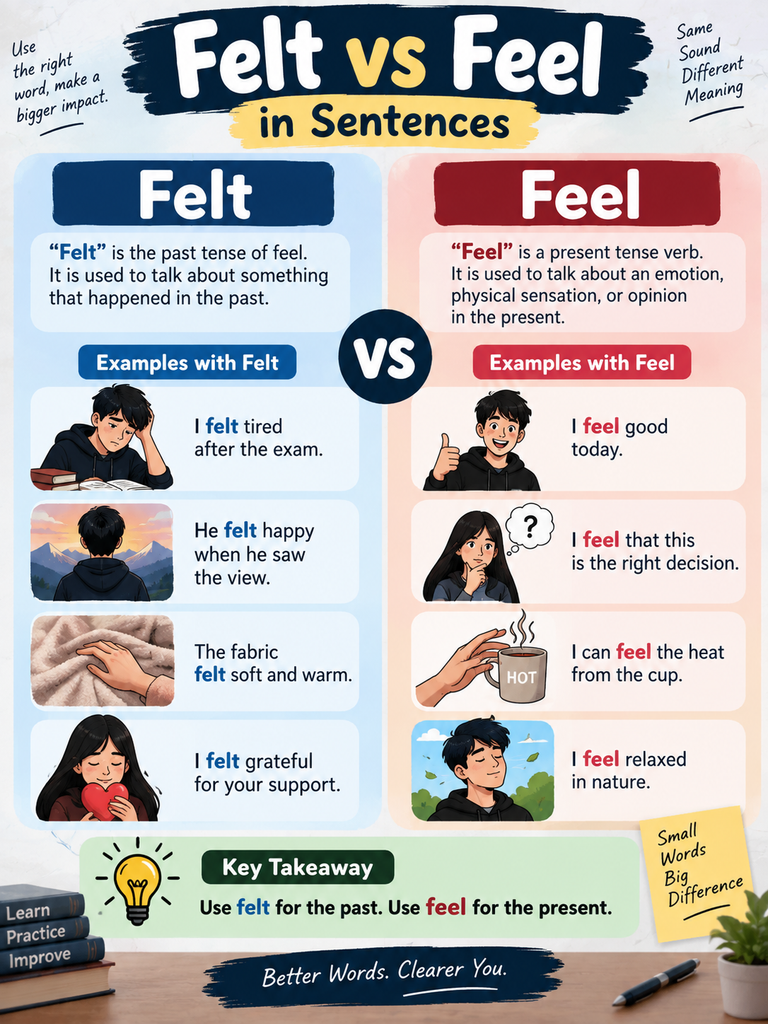
| Situation | Feel (Present) | Felt (Past) |
| Emotion | I feel excited. | I felt excited yesterday. |
| Physical sensation | I feel cold. | I felt cold last night. |
| Opinion | I feel this is unfair. | I felt this was unfair back then. |
| Reaction | She feels nervous now. | She felt nervous during the test. |
Also Read SN Meaning On Meaningpeak.com
Grammar Rules for Felt and Feel
- “Feel” is a stative verb, meaning it describes a state, not an action.
- “Felt” works as both simple past tense and past participle.
- Neither word usually takes the continuous “-ing” form in its basic sense.
- Both pair naturally with adjectives: feel happy, felt happy.
Felt vs Feel in Questions
- “How do you feel today?” (present)
- “How did you feel yesterday?” (past)
- “Do you feel okay?” (present)
- “Did you feel okay after the flight?” (past)
Felt vs Feel in Negative Sentences
- “I do not feel well today.”
- “She does not feel comfortable here.”
- “I did not feel ready for the test.”
- “They did not feel excited about the trip.”
Felt vs Feel in Continuous Tense
“Feel” is usually not used in continuous form because it describes a state rather than an ongoing action. Saying “I am feeling happy” is possible but less common than the simple “I feel happy.” “Felt” almost never takes a continuous form at all.
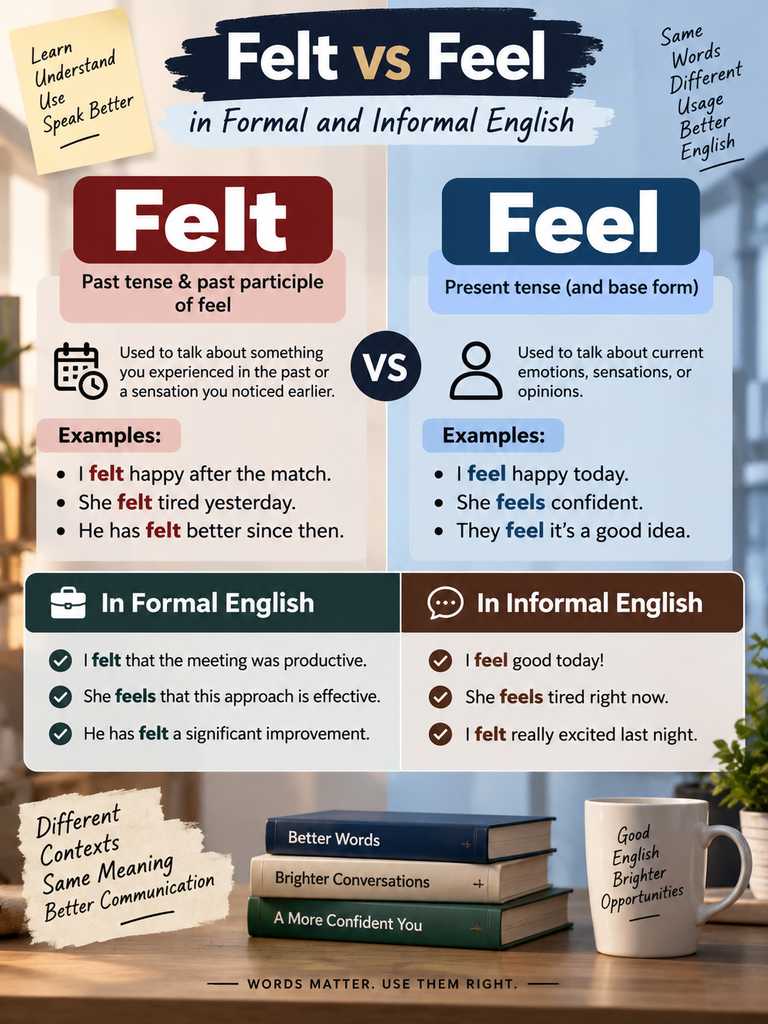
Felt vs Feel in Formal and Informal English
Formal
- “I feel that this proposal requires further review.”
- “She felt the decision was appropriate given the circumstances.”
Informal
- “I feel kinda tired ngl.”
- “I felt so proud when we won.”
Felt vs Feel in Writing and Speaking
In writing, tense consistency matters more, since readers rely on it to follow the timeline of events. In speech, people sometimes blend tenses without noticing, but written English still needs the correct form to stay clear.
Felt vs Feel with “That” Clauses
Both words often introduce an opinion or belief using “that.”
- “I feel that this is the right decision.”
- “She felt that something was wrong.”
Felt vs Feel in Real-Life Conversations
- “How do you feel about the new job?”
- “I felt so relieved after the call.”
- “He feels like something is missing.”
- “We felt amazing after the trip.”
Felt vs Feel in Emotional Expression
Both words carry emotional weight, but the tense changes how personal or distant the feeling sounds. “I feel hurt” sounds immediate and raw. “I felt hurt” sounds more reflective, like the person has already processed it.
Felt vs Feel in Storytelling
Storytelling relies heavily on “felt” since most narration happens in the past tense.
- “She felt a chill run down her spine.”
- “He felt the tension in the room.”
“Feel” appears in storytelling only when writing in present tense narration, which is less common but still used in some fiction.
Why Felt vs Feel Is Important
Choosing the right form keeps your sentences clear and grammatically correct. The wrong tense can confuse the timeline of what you’re describing, especially in writing where tone and timing matter.
Examples in Daily Life
Present
- “I feel great this morning.”
- “This chair feels comfortable.”
Past
- “I felt great after the workout.”
- “That movie felt really long.”
Similar Words to Feel
| Word | Meaning |
| Sense | To perceive something |
| Experience | To go through something |
| Perceive | To become aware of something |
| Believe | To hold an opinion |
Felt as a Noun (Different Meaning)

“Felt” also exists as a completely different word — a type of soft, dense fabric made from pressed fibers, often used in crafts or hats. Example: “The table was covered with green felt.”
Tips to Remember Felt vs Feel
- Match the word to a time marker: “now” pairs with feel, “yesterday” pairs with felt.
- Read the sentence aloud — the wrong tense usually sounds off.
- Remember: feel is today, felt is memory.
- Practice with short daily examples until it becomes automatic.
Common Expressions with Feel and Felt
Feel
- Feel free
- Feel like a million bucks
- Feel under the weather
- Feel at home
Felt
- Felt a connection
- Felt on top of the world
- Felt out of place
- Felt a weight lift
FAQs
Is feel present or past tense?
Feel is present tense, used for emotions or sensations happening now.
Is felt past tense or past participle?
Felt works as both the simple past tense and the past participle of feel.
Can I say “I feel yesterday”?
No, that’s incorrect. Use “I felt yesterday” since it refers to a past experience.
Can felt be used for present situations?
No, felt always refers to something that already happened, not the present.
What’s an easy way to remember the difference?
Connect feel with “now” and felt with “before” — that mental shortcut works every time.
Is feel used in continuous tense?
Rarely, since feel is a stative verb describing a state rather than an ongoing action.
Conclusion
“Feel” and “felt” both come from the same word, but timing sets them apart. Use “feel” for things happening now, and “felt” for things that already happened. This small shift changes the meaning of your whole sentence.
Next time you write, pause and ask when the feeling happened. That one question makes the choice between “feel” and “felt” simple every time.

Hi, I’m an SEO specialist with a strong passion for digital marketing and search optimization. I focus on understanding how search engines work and how websites can improve their visibility through effective SEO strategies.
I enjoy working with data-driven approaches, including keyword research, on-page optimization, technical SEO, and content strategy. I believe every website has the potential to grow and reach new heights with the right techniques and consistent effort.
I value continuous learning and always stay updated with the latest trends and best practices in the digital world. My goal is to keep improving my skills and knowledge while exploring new opportunities in the field of SEO.
