

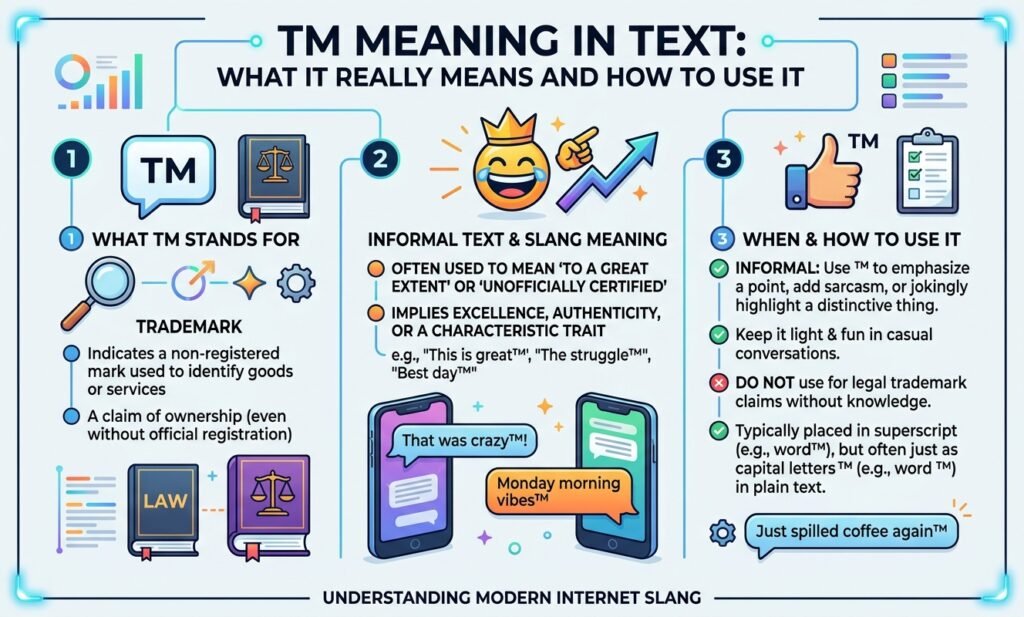
Have you ever seen “TM” in a text message and wondered what it means? It’s a common abbreviation used in casual texting and social media. Understanding it can help you follow conversations more easily.
“TM” usually stands for “trust me” or sometimes “text me,” depending on the context. People use it to sound confident or to ask someone to reach out. The meaning often depends on how it’s used in the sentence.
Knowing texting slang like “TM” makes online chats smoother and faster. It saves time and keeps conversations casual and friendly. Once you learn a few of these terms, texting becomes much easier to understand.
TM Full Forms in Text
Common Full Forms
TM doesn’t have one fixed definition. It’s more like a container word that gets filled in differently depending on the chat. Below are the most common full forms people use today.
| Full Form | Where It’s Used | Tone |
| Text Message | General texting, phone chats | Neutral |
| Too Much | Reacting to drama or a big reaction | Casual, expressive |
| Trust Me | Convincing someone, adding emphasis | Confident, reassuring |
| Trademark | Business, branding, legal writing | Formal |
Knowing which one fits takes a little practice, but once you see a few examples, the pattern becomes easy to spot.
TM Meaning as “Text Message”
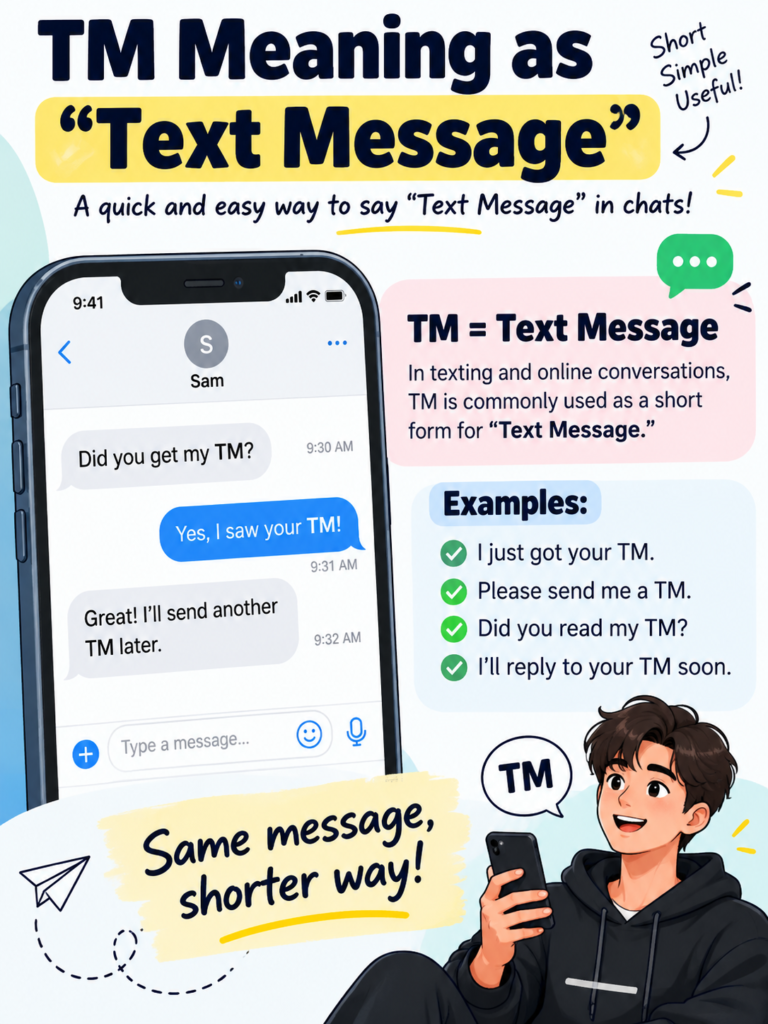
This is the most literal and widely recognized meaning. When someone says “send me a TM,” they’re simply asking for a text rather than a call or email.
Usage
- “I’ll TM you the address later.”
- “Don’t call, just TM me when you land.”
- “Check your TM, I sent the details.”
This version of TM is common in everyday phone conversations, especially when someone is choosing between calling, emailing, or texting.
TM Meaning as “Too Much”
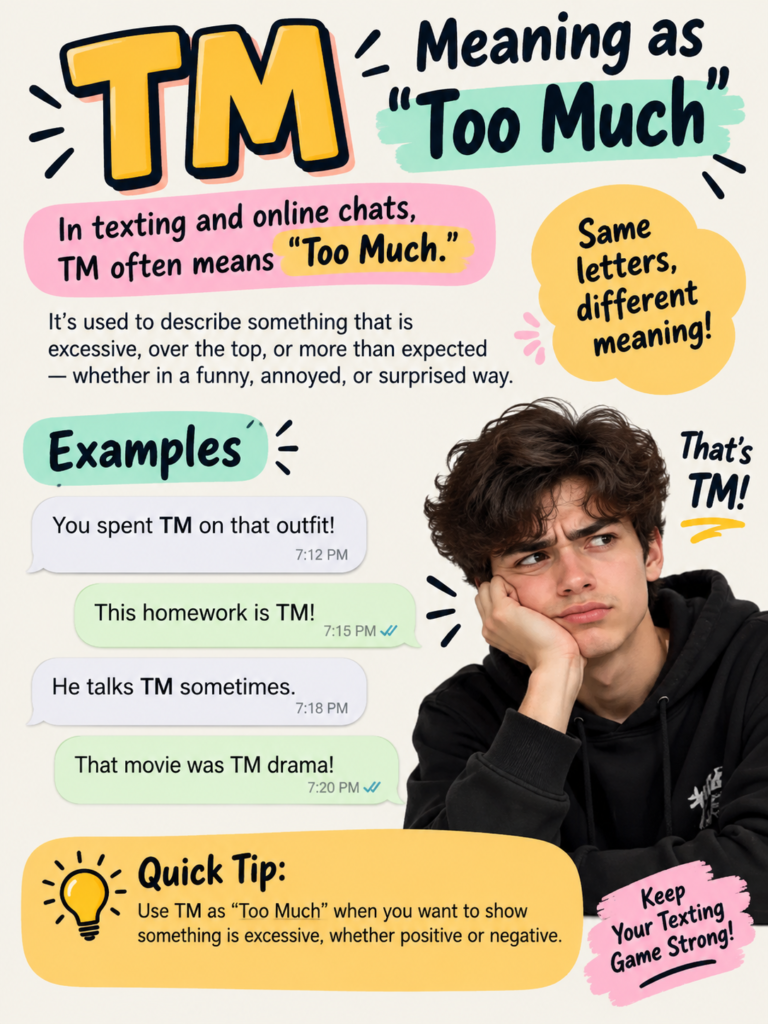
Here, TM becomes a reaction word. It shows up when someone finds a situation overwhelming, dramatic, or excessive, whether that’s emotionally heavy or just a lot to handle.
Usage
- “That drama at the party was TM.”
- “Honestly, his reaction was TM for a small mistake.”
- “This homework load is TM this week.”
This meaning leans casual and is common among younger texters who want to express a strong feeling without typing a full sentence.
TM Meaning as “Trust Me”
This use of TM works almost like a verbal nudge. It’s added at the end of a sentence to boost confidence in what was just said, similar to saying “I promise” or “for real.”
Usage
- “This movie is amazing, tm.”
- “He’s going to show up late, tm.”
- “Just wait, it gets better, tm.”
Notice how it often appears as a tag at the end rather than the start of a sentence. That placement is part of what makes it read as sincere rather than sarcastic.
TM Meaning as “Trademark”
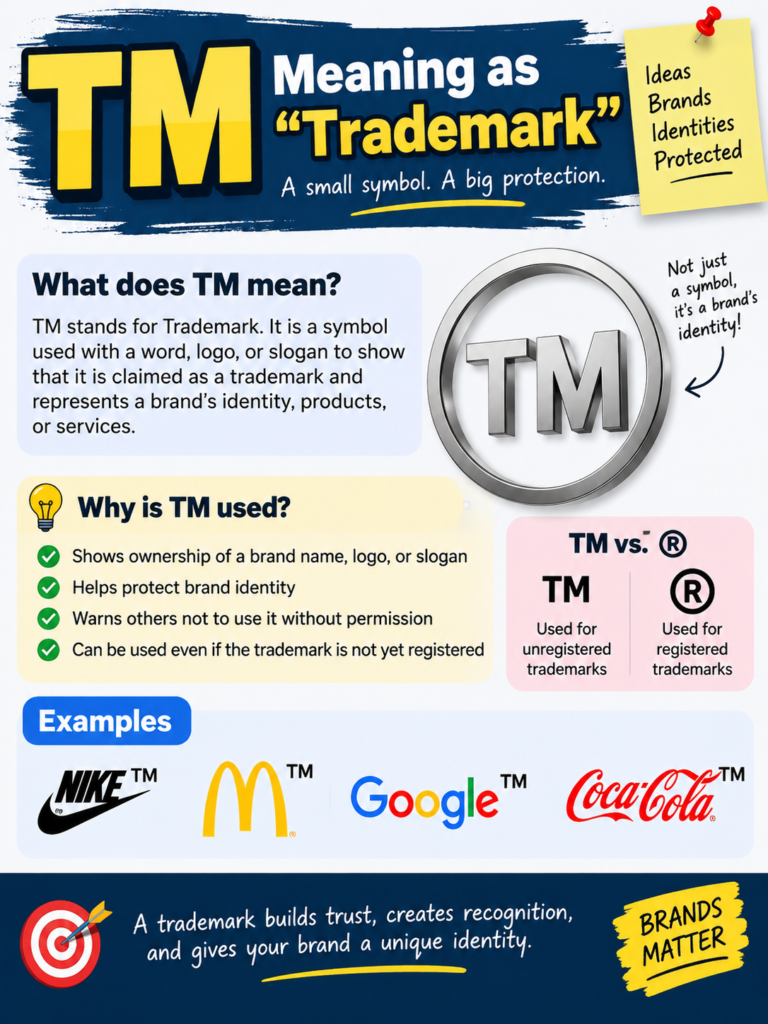
This is the original, legal meaning of TM, long before texting slang got hold of it. The ™ symbol represents an unregistered trademark, used by businesses to signal ownership of a brand name, logo, or slogan.
Usage
- “The new app name is TM protected.”
- “We can’t use that phrase, it’s TM by another company.”
- “Our logo design is TM pending registration.”
This meaning shows up in business emails, marketing copy, and legal documents far more than in casual chats.
Also Read LWK MEANING On MeaningPeak.com
TM Meaning in Social Media
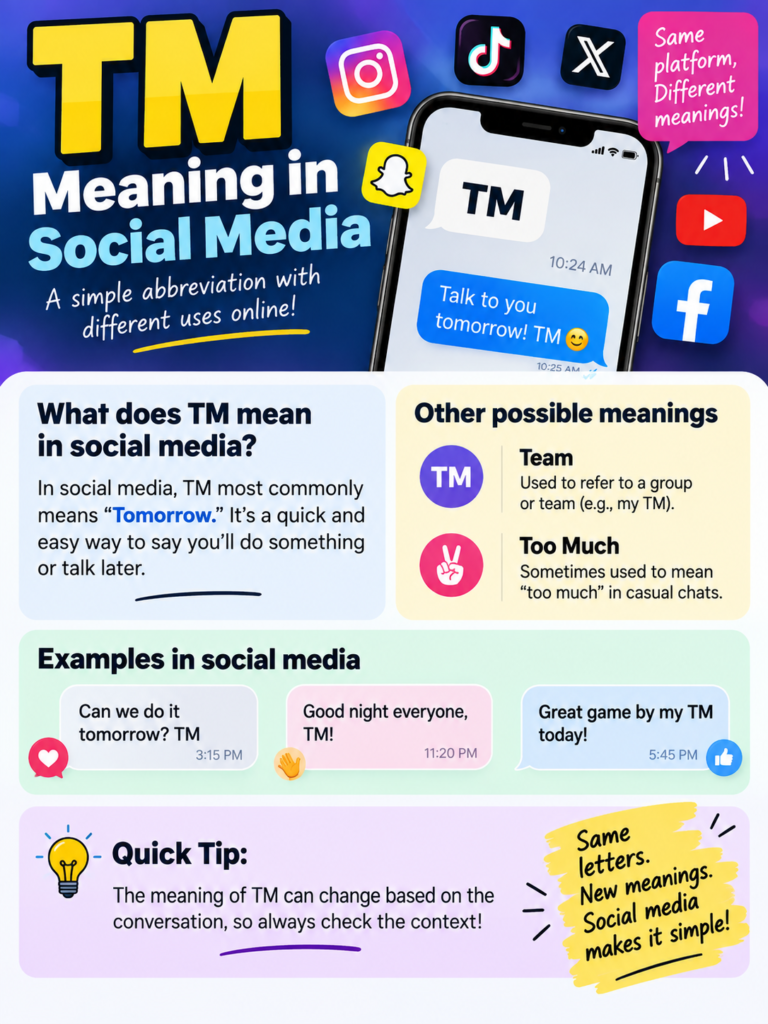
Different apps bring out different shades of TM. Here’s how it typically plays out across the major platforms.
TikTok
On TikTok, TM often appears in comments and captions, usually leaning toward “too much” or “trust me” depending on the video’s tone. It fits the platform’s fast, reactive style of communication.
Snapchat
Snapchat users lean toward “trust me” or a quick nod to plans (“talk more,” “tomorrow” in some regional slang). Context from the snap or caption usually clears up which one is meant.
On Instagram, TM shows up mostly in comments and captions as a vibe-based shorthand, often paired with emojis to strengthen the tone, whether that’s excitement, sarcasm, or emphasis.
WhatsApp leans more literal. Because it’s a messaging-first app, TM here usually just means “text message” or is used casually between friends without much ambiguity.
How to Use TM in Text Messages
Tips
- Look at the sentence before and after TM for context clues.
- Match the tone: casual chats usually mean “too much” or “trust me,” while business messages usually mean “trademark” or “text message.”
- Don’t overuse it in formal writing, like emails to a manager or a client.
- Pay attention to punctuation. A period after “tm” can feel more final, while an exclamation mark reads as excited or sincere.
Correct Usage Examples
- Casual: “That show finale was TM, I’m still shaking.”
- Reassuring: “He’s a good guy, tm.”
- Business: “This slogan is already TM registered.”
- Everyday: “I’ll TM you once I’m home.”
Examples of TM in Sentences
- “TM me the details when you get a chance.” (Text Message)
- “Her outfit today was TM, in a good way.” (Too Much)
- “This plan will work, tm.” (Trust Me)
- “The brand name is fully TM protected.” (Trademark)
Is TM Formal or Informal?
Informal Usage
In everyday chats, TM is almost always informal. It belongs in group chats, DMs, and casual conversations where speed and tone matter more than grammar rules.
Not Formal
TM is not appropriate in formal writing, resumes, or professional reports, except when it’s used in its original legal sense to indicate a trademark. Outside of that specific case, it reads as too casual for formal contexts.
Why People Use TM in Text
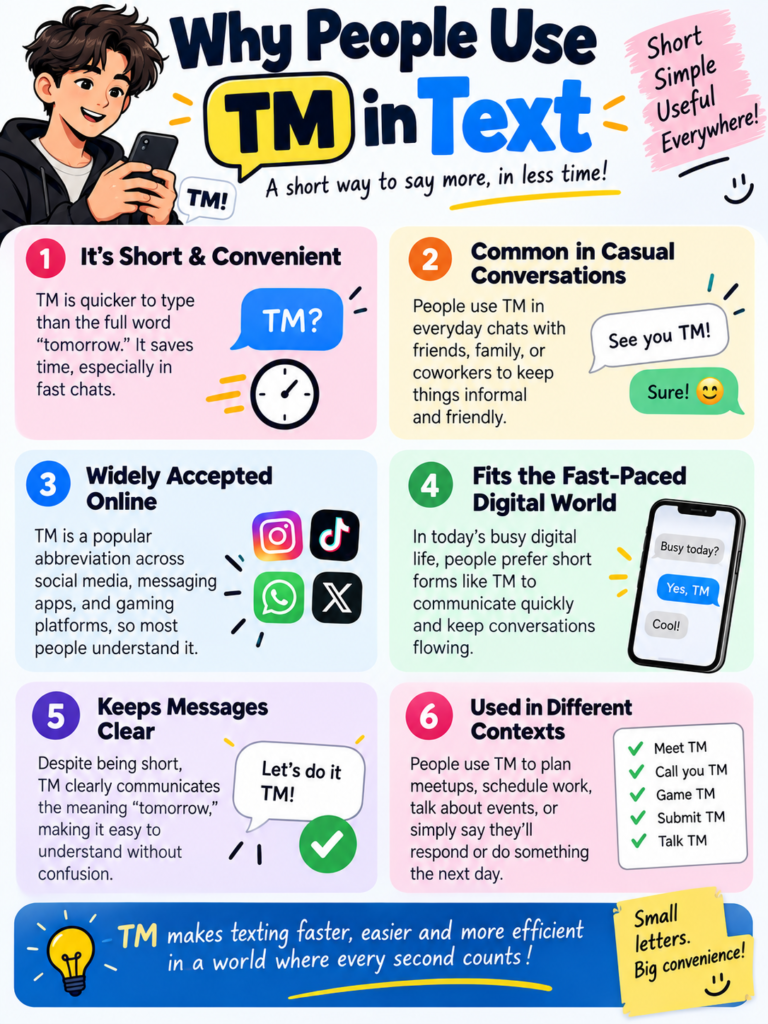
Reasons
- Speed two letters are faster to type than a full word.
- Habit texting culture rewards short, punchy replies.
- Tone control TM can soften or emphasize a statement without extra words.
- Platform norms many apps encourage brief, quick-fire messaging styles.
Advantages and Disadvantages of TM
Advantages
- Saves time while typing
- Keeps conversations light and fast
- Works across multiple platforms
- Easy to learn once the pattern clicks
Disadvantages
- Can confuse people unfamiliar with the slang
- Multiple meanings can lead to misreads
- Not suitable for formal or professional writing
- Tone can be misunderstood without context
Similar Slang Words to TM
- BRB Be Right Back
- IDK I Don’t Know
- HMU Hit Me Up
- NGL Not Gonna Lie
- FR For Real
These abbreviations follow the same logic as TM: short, fast, and context-dependent.
TM Meaning in Different Contexts
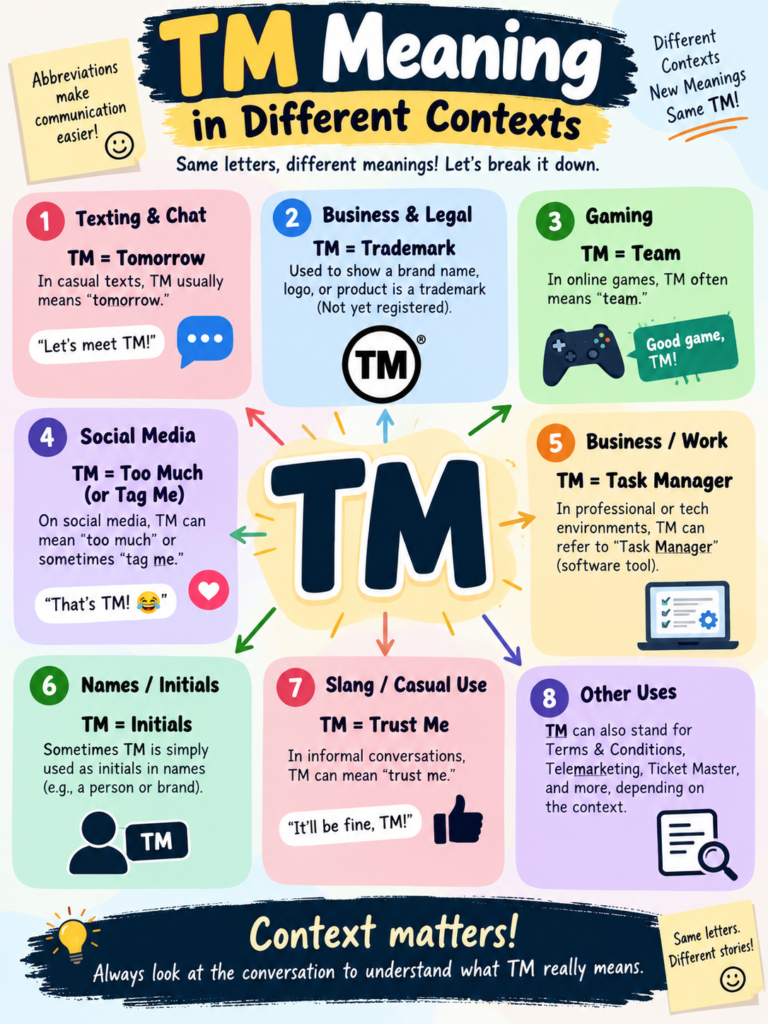
Texting
In one-on-one texting, TM usually leans toward “text message” or “trust me,” depending on how the sentence is framed.
Casual Chat
In group chats and casual banter, TM often takes on the “too much” meaning, especially when reacting to something dramatic or funny.
Conversation
In spoken-style online conversation, like comment threads, TM works more like a verbal filler, adding emphasis rather than carrying a strict definition.
FAQs
What does TM mean in a text message?
TM usually means “Text Message,” but depending on context it can also mean “Too Much,” “Trust Me,” or “Trademark.”
Is TM the same as the trademark symbol?
Not always. The legal ™ symbol always means trademark, but lowercase “tm” in texting slang often means something completely different.
Is TM formal or informal?
TM is informal slang, except when used in its original legal sense to indicate a trademark in business writing.
Which platforms use TM the most?
TM appears frequently on TikTok, Snapchat, Instagram, and WhatsApp, with slightly different meanings on each.
How do I know which meaning of TM is being used?
Read the full sentence and the conversation around it. The tone, topic, and platform usually make the intended meaning clear.
Conclusion
In the end, “TM” is just a simple text shortcut people use every day. It can mean “trust me” or “text me,” based on the context. Once you spot the pattern, it’s easy to understand.
Texting slang like this makes chatting quicker and more fun. You don’t need to guess anymore when you see “TM” in a message. Now you can use it yourself with confidence.

Hi, I’m an SEO specialist with a strong passion for digital marketing and search optimization. I focus on understanding how search engines work and how websites can improve their visibility through effective SEO strategies.
I enjoy working with data-driven approaches, including keyword research, on-page optimization, technical SEO, and content strategy. I believe every website has the potential to grow and reach new heights with the right techniques and consistent effort.
I value continuous learning and always stay updated with the latest trends and best practices in the digital world. My goal is to keep improving my skills and knowledge while exploring new opportunities in the field of SEO.
